Early Bird Phase 2 is live | Flat: 50% Off |
Back to Case Studies
Leadership 4 min read

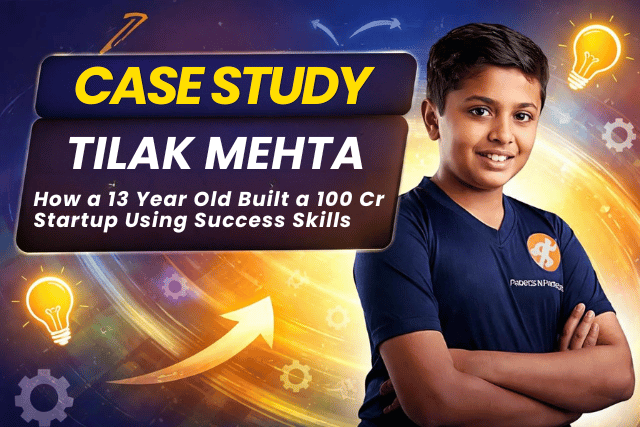
Tilak Mehta Case Study: How a 13-Year-Old Built a Startup Using Core Success Skills

The Founder Kid

The Founder Kid Team

Inspiring the next generation

Tilak Mehta Case Study: How a 13-Year-Old Built a Startup Using Core Success Skills
Tilak Mehta: A Young Entrepreneur | The Founder Kid
Back to Blog
Real Founder Story Entrepreneurship 4 min read

Tilak Mehta Case Study:
How a 13-Year-Old Built a Startup Using Core Success Skills

A Founder's Journey

When most kids his age were busy with homework and cricket...

Tilak Mehta was solving a real-world problem — and building a company worth crores in the process.

13
Age When Started
300+
Dabbawala Partners
₹100Cr
Revenue Milestone
Your reading journey — 6 steps ahead
Step 1Step 2Step 3Step 4Step 5Step 6
1
The Spark

It Started With a Book

In 2018, a young Tilak Mehta needed to retrieve a book from his uncle's house — on the other side of Mumbai. He tried the usual courier services. They were either too expensive, too slow, or simply unavailable for same-day delivery within the city.

Frustrated, he did what most kids his age wouldn't — instead of giving up, he asked himself: why is same-day delivery within a city this big so hard?

That one question became Papers N Parcels — a same-day, intracity delivery startup that would go on to capture national attention and inspire thousands of young Indians to think like founders.

Tilak didn't invent a new delivery network. He recognised an existing one — Mumbai's legendary Dabbawala system, trusted, punctual, and already on the road every single day — and found a smarter way to use it.
2
The Strategy

The Dabbawala Partnership

Mumbai's Dabbawalas have operated for over 125 years, delivering home-cooked meals to office workers with a near-perfect accuracy record that Harvard Business School has studied. They are an icon of Indian logistics — trusted, affordable, and spread across every neighbourhood of the city.

Tilak saw what everyone else had missed: these Dabbawalas had enormous capacity to carry more than just dabbas. By partnering with the Dabbawala Union and building a tech layer — a mobile app — on top of their existing network, he created a same-day delivery service with no fleet costs, no recruitment overhead, and instant scale.

He brought in his father as co-founder, pitched the Dabbawala Union, and signed on over 300 partners. Papers N Parcels was live within months.

"Age is just a number. The idea matters more than who has it."
— Tilak Mehta, Founder, Papers N Parcels
3
The Timeline

His Journey, Year by Year

2018 — Age 13 — The idea
Spots the gap in same-day Mumbai delivery. Conceptualises Papers N Parcels and convinces his father to co-found with him.
2018 — Launch
Partners with the Dabbawala Union. Onboards 300+ Dabbawalas. Launches the app and acquires first customers within weeks.
2019 — Recognition
Featured in major national and international media. Appears on television and begins speaking at schools and startup events across India.
2020–21 — Pandemic pivot
Adapts operations during COVID-19 — shifting focus to essential goods and medicine delivery when traditional demand patterns changed overnight.
Ongoing — Scaling up
Continues growing operations, speaking at events, and becoming one of India's most recognisable young entrepreneur voices.
4
The Analysis

What Made This Work? The Founder Mindset.

Tilak's story isn't just inspiring — it's instructive. Break down what he did and you'll find classic founder thinking that any child can learn:

Critical Thinking
Most people would think, "I need to hire delivery boys and buy bikes." That requires massive capital. Tilak thought critically: "Who is already moving across Mumbai every single day with perfect accuracy?" * The Solution: The Mumbai Dabbawalas. He didn't build a new logistics network; he layered his tech over an existing, highly efficient one. That is high-level critical thinking.
Networking
Tilak networked with the head of the Dabbawala Association. He didn't just ask for a favor; he pitched a mutually beneficial partnership. He offered the Dabbawalas a way to earn extra income during their idle time (after lunch deliveries) without changing their routes. His ability to negotiate and build trust with seasoned adults was the linchpin of the business.
Financial Literacy
By partnering with the Dabbawalas, his Capital Expenditure (CapEx) was virtually zero. He didn't have to buy vans, pay for fuel, or hire full-time drivers. He understood pricing strategy—keeping parcel delivery costs between ₹40 and ₹150. This severely undercut traditional couriers while ensuring enough margin to pay the Dabbawalas fairly and keep the business profitable.
Self-Branding
He confidently positioned himself as "India's Youngest Entrepreneur." He took the stage at TEDx, spoke at Forbes events, and gave countless interviews. By building unshakeable confidence to speak publicly, his personal brand became the primary growth engine for Papers N Parcels. People weren't just buying a courier service; they were investing in the inspiring story of a 13-year-old founder.
5
The Takeaway

What Parents and Kids Can Learn

Tilak's parents didn't tell him to "focus on your studies first." His father listened, believed in the idea, and became his first advisor and co-founder. That support structure was critical. It's also something every family can build — not by funding a startup, but by simply taking ideas seriously.

The founder mindset isn't a certificate or a course. It's a habit of seeing problems and asking "what if I tried to fix this?" — and it forms between the ages of 8 and 14, not after Class 12.

Try This at Home
At dinner this week, ask your child: "Name one thing in our city that's broken or annoying. How would you fix it with ₹5,000 and your two best friends?" Don't critique the answer. Don't redirect to homework. Just listen — you might be surprised at what comes out.
6
The Future

India's Next Wave Is Already Here

Tilak Mehta isn't a once-in-a-generation anomaly. He's a preview. India has over 600 million people under the age of 25 — the world's largest young population. If even a fraction of them are given the right tools, encouragement, and environment to think like founders, the next decade will be extraordinary.

The skills that made Tilak successful — curiosity, problem-spotting, resilience, and resourcefulness — aren't rare gifts. They are learnable. They just need to be taught early, before the "study hard → get a job" script sets in.

The startup founders of 2040 are sitting in classrooms right now. Some of them are your children — waiting for someone to tell them their idea is worth pursuing.

Quick Recap
6 traits of a young founder mindest
Observe problems closely
Leverage existing assets
Ask for help without ego
Act before you are ready
Value parental support
Start as early as possible
Parents Also Ask
Common questions about teaching kids and money
He built Papers N Parcels — a same-day intracity delivery platform that uses Mumbai's Dabbawala network as the logistics backbone. Customers book deliveries through an app, and trained Dabbawalas handle the pickup and drop within the same day.
Start by encouraging your child to notice and name problems around them — in school, at home, in the neighbourhood. Don't jump to solutions for them. Ask "how would you fix it?" Structured programs like The Founder Kid then build on that curiosity with real skills: pitching, budgeting, teamwork, and iteration.
Absolutely not. The founder mindset is about how you approach every challenge — with curiosity, resilience, and the belief that you can figure it out. A doctor with it builds better healthcare systems. An engineer with it creates products that actually solve problems. A student with it thrives in any career.
The habits of curiosity, creative thinking, and problem-solving form most powerfully between ages 8 and 14. Waiting until after Class 12 means missing the most formative window. Tilak was 13. The earlier, the better.
Join The Founder Kid

Give Your Child the Mindset India Needs Most

The Founder Kid is built for children aged 8–16 who are ready to think bigger — with gamified learning, real challenges, and future-ready skills that no textbook teaches.

What's Your "Do Something" Moment?

We all have those moments where we can choose to complain or choose to act. What will your child choose? By instilling the "Do something" philosophy early on, we equip them with the tools they need to navigate challenges, seize opportunities, and leave their mark on the world.

Share this story