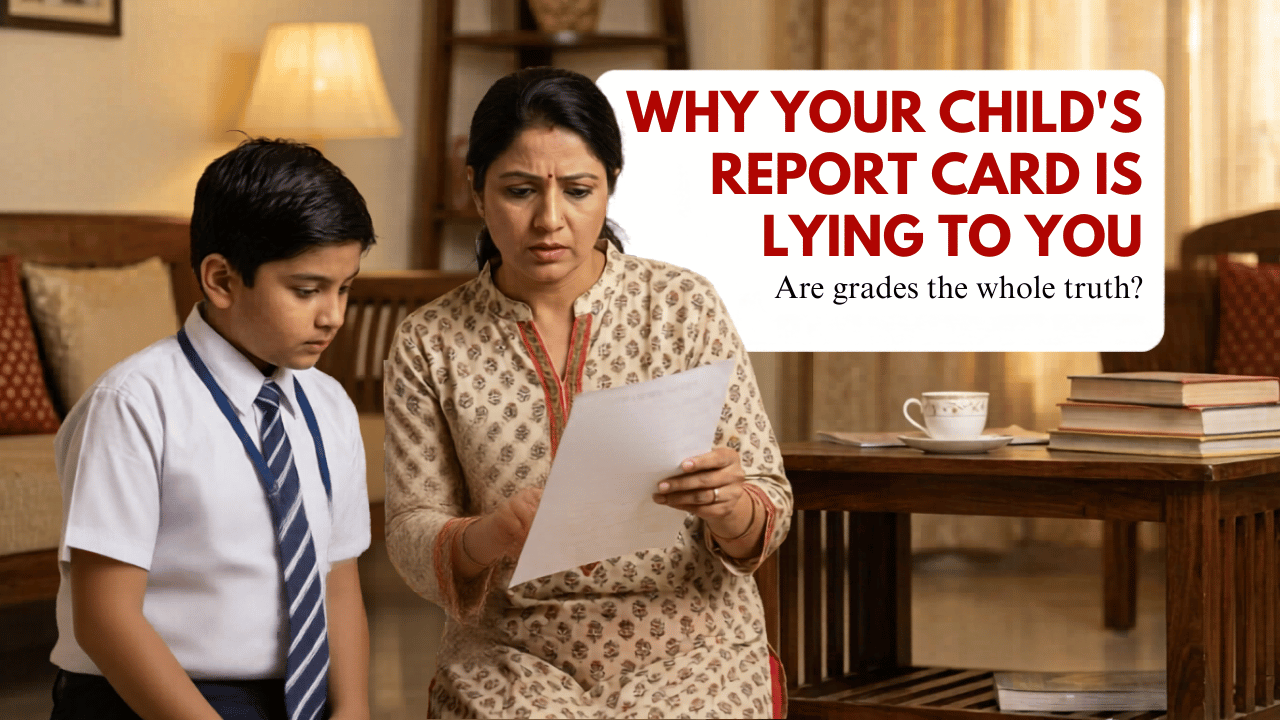
What the Report Card Actually Measures
The Indian education system was designed for a different era — one where memorizing facts and scoring high on standardized tests was genuinely valuable. When information was scarce, the person who could recall the most held real power.
That world no longer exists.
Today, your child can find any fact in under 10 seconds on their phone. AI tools like ChatGPT can generate essays, solve equations, and summarize entire textbooks in moments. Memorization — the very thing report cards reward — has been devalued by technology.
- Ability to recall information under pressure
- Compliance with a structured system
- Short-term retention before the next exam
- The ability to solve a problem nobody has seen before
- How well your child communicates and persuades
- Whether they can manage money, build relationships, or think critically
The "Same Start, Different Finish" Phenomenon
Here's what makes this truly eye-opening.
Researchers tracked professionals who started their careers with identical qualifications — same college tier, similar GPAs — and observed them 10 years later. The divergence in outcomes was staggering.
The high-achievers had received 4.2 promotions on average. The stagnant group had received just 1.5.
When asked what made the difference, the high-achievers didn't credit their degrees. They pointed to skills like strategic thinking, financial confidence, knowing how to build a network, and being able to articulate their own value.
So What Actually Predicts Success?
Research consistently points to five foundational skills that separate high-performers from everyone else — regardless of their academic background:
These aren't "soft skills." They are the operating system that determines how well everything else runs — including whatever technical skills your child develops in the future.
The Window You Don't Want to Miss
Here's the good news: these skills can be deliberately taught and learned. And research shows the best time to build them is between ages 9 and 14, when the adolescent brain is most receptive to abstract thinking, reasoning, and self-awareness.
Waiting until college is too late. The habits, mindsets, and frameworks that determine career trajectories are being formed right now — in your child's middle school years.
What You Can Do Starting Today
The report card isn't going away, and grades still matter for college admissions. But as a parent, you can make sure that isn't the only thing being built.
- Ask different questions at the dinner table: not "what did you score?" but "what problem did you solve today?"
- Give your child real financial decisions to make: even small ones like managing a weekly budget.
- Encourage projects over cramming: help them build something, pitch something, or create something they're proud of.
- Celebrate curiosity: not just correct answers.
The parents who understand this shift early are the ones raising children who won't just get their first job — they'll build careers that compound over decades.
Your child's potential was never on that report card. It's in how they think, connect, and adapt. That's what The Founder Kid is here to build.
Parents Also Ask
Your Child Has the Spark. Now Give It the Right Environment.
At The Founder Kid, we take children with natural curiosity, leadership, and creativity and give them the structured skills to turn those traits into real-world confidence — through gamified, hands-on learning built for India's future founders.